

Why 'Bouncing Back' is Dead (And What to Do Instead) for 2026 Healthcare Leaders
If you’ve spent any time in a leadership role within healthcare over the last decade, you’ve heard the phrase "bounce back" more times than you can count. It’s the standard rallying cry after a budget cut, a staffing crisis, or a global health emergency. The image is simple: you’re a rubber band. You get stretched to the limit, and then: through sheer "resilience": you snap back to your original shape.
But here’s the cold, hard truth I’m seeing on the ground in 2026: The rubber band is broken.
In today’s healthcare landscape, there is no "back" to bounce to. We aren't dealing with temporary storms anymore; we are living in a completely new climate. Between the long-term structural shifts from the One Big Beautiful Bill Act (OBBBA) and the permanent integration of AI-driven clinical operations, the "old normal" has been erased.
If you’re still trying to bounce back, you’re not practicing leadership resilience: you’re practicing nostalgia. And in a sector as high-stakes as ours, nostalgia is a recipe for burnout.
The Fallacy of the "Normal"
I’ve found that the biggest drain on a leader’s energy isn't the work itself: it’s the friction of trying to return to a state that no longer exists.
Think about the structural shifts we’ve navigated recently. We’ve seen over a trillion dollars in projected cuts over the next decade. We’ve moved toward digital-first networks that have fundamentally changed how we interact with patients and payers. These aren't cyclical changes that will eventually swing back. They are structural.
When we tell our teams to "hang in there until things get back to normal," we are unintentionally lying to them. Worse, we are setting them up for a cycle of perpetual disappointment. Real leadership development for healthcare in 2026 requires a pivot from "recovery" to "evolution."
Introducing Forward-Looking Momentum
Instead of bouncing back, I want to talk to you about Forward-Looking Momentum.
This isn't just a corporate buzzword. It’s a shift in mindset where we stop looking at adversity as a detour and start looking at it as the road itself. Resilience shouldn't be defined by how well you can withstand a blow; it should be defined by how effectively you can use the energy of that blow to propel yourself forward.
I’ve seen firsthand that the leaders who are thriving right now aren't the ones with the thickest skin. They are the ones with the clearest sight. They’ve traded the "survivor" mentality for a "navigator" mentality.

The PR6 Lens: Vision and Tenacity
At Frederick Solutions LLC, we use the PR6 Resilience Model to help executives move beyond simple stress management. To handle the structural shifts of 2026, two domains stand out as non-negotiable: Vision and Tenacity.
1. Vision: Seeing Through the Fog
In the PR6 framework, Vision isn't about having a five-year plan written in stone. It’s about clarity of purpose. When the system around you is shifting: when budgets are tight and the "how" of your work is changing daily: your "why" must be unshakable.
I often ask the leaders I coach: Is your vision tied to a specific process, or is it tied to an outcome?
If your vision is "to run this department exactly like we did in 2022," you’re going to fail. But if your vision is "to ensure equitable patient outcomes regardless of the funding model," you’ve suddenly given yourself the permission to innovate. Vision allows you to stop mourning the old tools and start mastering the new ones. It’s the "north star" that prevents you from getting lost when the map changes.
2. Tenacity: The Marathon Mindset
We used to think of grit as a sprint: just get through this one crisis. But 2026 has shown us that healthcare leadership is a series of ultra-marathons. Tenacity in the PR6 model is about purposeful persistence.
It’s not just about "working hard." It’s about the disciplined application of effort over time. Tenacity is what allows you to stick to your Vision when the initial excitement of a new initiative fades and the reality of systemic resistance sets in. It’s the quiet voice at the end of a long day that says, "I will try again tomorrow, but I will try differently."
Executive resilience coaching is often the key to unlocking this domain. It’s hard to stay tenacious when you’re isolated. You need a sounding board to help you distinguish between a brick wall that needs to be climbed and a dead end that needs to be abandoned.
Why Your Current Strategy Might Be Failing
If you feel like you’re doing all the "right" things: wellness apps, occasional days off, "mandatory fun" team builders: and you’re still exhausted, it’s probably because those are recovery strategies, not resilience strategies.
Recovery is about resting so you can go back into the fray. Resilience is about changing your relationship with the fray so it doesn't deplete you in the first place.
I’ve written before about how wellness programs often fail because they address the symptoms rather than the systemic design of our work. To truly lead effectively in 2026, you have to look at the six domains: Vision, Composure, Reasoning, Health, Tenacity, and Collaboration.
If you’re neglecting your Health (physical and mental), your Tenacity will eventually crumble. If you lack Collaboration, your Vision will never leave your own head. It’s a holistic system.
Actionable Steps for the 2026 Leader
So, what do you do instead of trying to bounce back? Here is a roadmap I’ve found effective for my clients:
Audit Your Language: Stop saying "when things get back to normal." Start saying "as we navigate this shift." It sounds small, but it changes the psychological expectation for you and your team.
Reconnect with the PR6 Vision: Take fifteen minutes this week to write down your core purpose. Not your tasks, but your purpose. Does it still hold true in this new environment? If not, it’s time to update it.
Invest in Reasoning: Use the Reasoning domain of the PR6 to look at challenges objectively. Instead of reacting emotionally to a budget cut, ask: "What does this new constraint allow us to stop doing that wasn't working anyway?"
Seek External Perspective: Leadership is lonely, and internal perspectives are often clouded by organizational "groupthink." Whether it’s through a mentor or advanced leadership coaching, get an outside view.
The Path Forward
The "Bouncing Back" era of healthcare leadership is officially over. The leaders who will define the next decade are those who understand that resilience isn't a return to form: it’s an evolution of function.
We are building the future of healthcare in real-time. It’s messy, it’s taxing, and it’s arguably the most important work of our careers. But you don't have to do it on an empty tank, and you certainly don't have to do it alone.
If you’re ready to stop just "getting through it" and start leading with Forward-Looking Momentum, I’d love to help you build the tools you need.
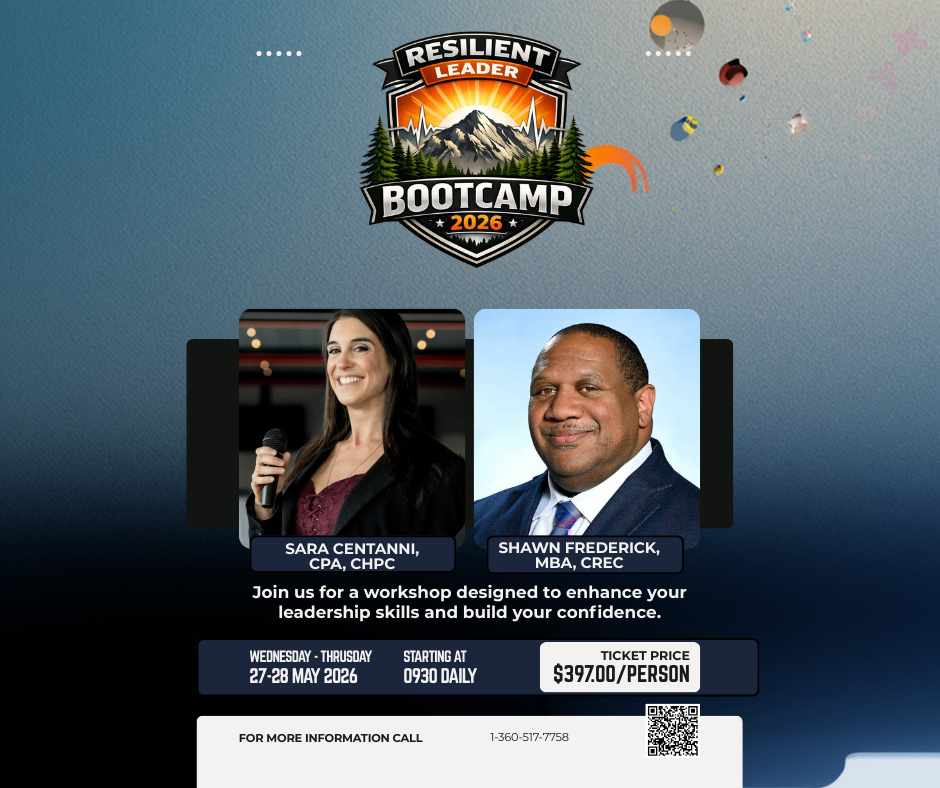
Join Me: Resilient Leader Bootcamp 2026
I’m hosting an intensive, two-day event designed specifically for leaders in high-stress sectors like ours. We’re going deep into the PR6 domains, providing you with a practical toolkit to prevent burnout and lead your team through the structural shifts of the modern era.
Event Details:
When: May 27-28, 2026 (Starts at 9:30 AM)
Where: Lake Stevens, WA
Investment: $397 (Use code EARLYBIRD20 for a special discount)
This isn't another "sit and listen" seminar. It’s a workshop where you’ll walk away with a personalized resilience roadmap.
Together, we can move past the myth of "bouncing back" and start building a version of leadership that is stronger, clearer, and more sustainable than anything we’ve seen before.
Let's get to work.


Comments