

Leadership Burnout Vs. Systemic Design: Why Your Resilience Alone Won’t Fix a Broken Culture
If you’ve been in a leadership role within healthcare or public health for more than five minutes lately, you’ve heard the word "resilience" more times than you can count. It’s become the go-to prescription for everything from staffing shortages to budget cuts. "We just need a more resilient workforce," the saying goes.
But I want to be honest with you: as someone who spends every day coaching executives and training teams on mental resilience, I know that resilience alone isn’t going to save us.
I’ve sat across from brilliant, dedicated leaders who are doing all the "right" things. They practice mindfulness. They exercise. They’ve gone through my TALK ONE sessions and mastered the somatic hacks to regulate their nervous systems in high-stress moments. And yet, they are still exhausted. Why? Because you can’t "breathe" your way out of a toxic culture or a structurally broken system.
In this post, I want to explore the tension between individual grit and systemic design. We’ll look at why your personal resilience is a necessary tool, but also why it’s actually a bridge to something bigger: the responsibility to redesign the environments we lead.
The Resilience Trap: When "Toughing it Out" Becomes the Problem
For years, the professional world has treated burnout as an individual failing. If you’re burned out, the logic goes, you didn't manage your stress well enough. You didn't set enough boundaries. You didn't take enough "self-care" days.
This is what I call the Resilience Trap.
When we frame burnout purely as a lack of individual resilience, we shift the burden of a failing system onto the shoulders of the people suffering within it. In healthcare and public health, this is especially dangerous. We are dealing with systems that were often built for a different era: optimized for 100% utilization with zero "slack" for recovery or human error.
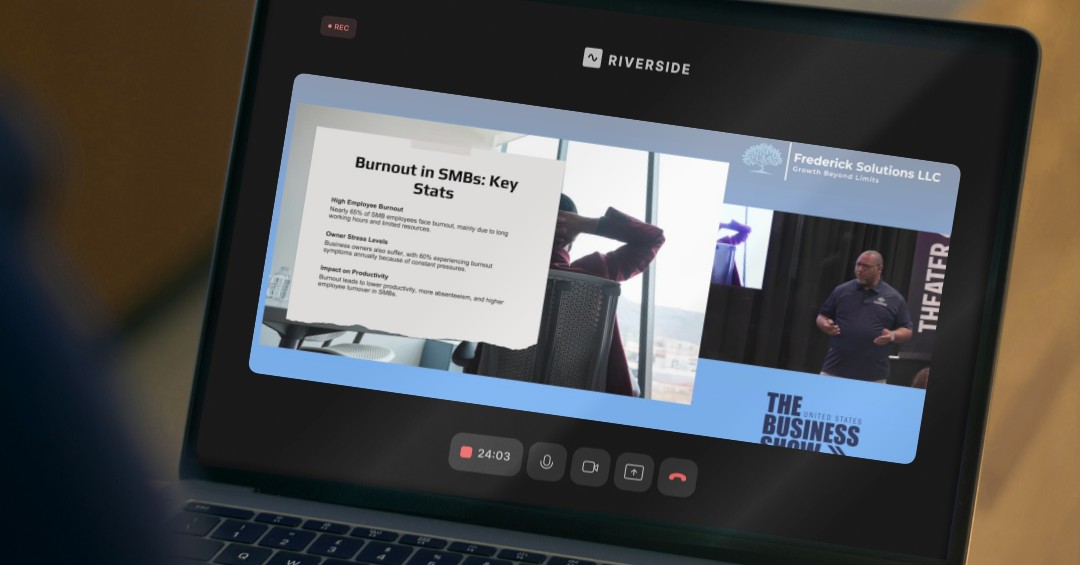
As the research suggests, burnout stems from broken organizational systems, not individual weakness. No amount of personal grit can overcome a workload that is mathematically impossible to complete in a 40-hour (or 60-hour) week. When we tell leaders to "just be more resilient," we are often asking them to become better at absorbing dysfunction. That’s not leadership; that’s a recipe for a total collapse.
Resilience as the Oxygen Mask (TALK ONE)
If resilience isn't the final fix, why do I still focus so heavily on it in my 1:1 coaching and TALK ONE sessions?
Because you cannot fix a broken system if you are drowning alongside it.
Think of individual mental resilience as your oxygen mask. You’ve heard the flight attendant's speech: "Secure your own mask before assisting others." In a high-stress sector like ours, mental resilience is what keeps your prefrontal cortex online when the "fire" starts. It’s what prevents you from making fear-based decisions or reacting with irritability when a staff member brings you a problem.
I’ve found that when leaders develop the skills to manage their internal state, they gain the clarity needed to look at the external system objectively. You can’t advocate for better staffing ratios or clearer decision-making protocols if your brain is in a permanent state of "fight or flight."
We use these resilience tools not to endure a broken culture forever, but to maintain the cognitive energy required to change it. The ultimate guide to mental resilience isn't about how to work harder: it’s about how to lead smarter while protecting your own humanity.
The Privilege of Leadership and Systemic Change (TALK TWO)
Once you’ve secured your oxygen mask, the real work begins. This is where we transition from "Self-Care" to "System Care."
In my TALK TWO session, "The Privilege of Leadership," I speak directly to new managers and supervisors about the weight of their new roles. Being a leader isn't just a title or a pay raise; it is a privilege that comes with the responsibility of creating psychological safety for others.

If you are a leader, you are the "architect" of your team’s daily experience. You might not be able to change the entire healthcare system overnight, but you can change the systemic design of your immediate department.
Here is how resilient leaders use their "Privilege of Leadership" to fight burnout systemically:
Auditing Invisible Emotional Labor: Who is doing the "worrying" in your department? Who is the one always smoothing over conflicts or keeping track of the team’s morale? This labor is often untracked and unrewarded, leading to "quiet burnout." Resilient leaders make this work visible and distribute it fairly.
Defining Decision Rights: A huge driver of executive burnout is the "friction" of unclear authority. If every small decision has to run through three committees, people feel powerless. Empower your team by clarifying exactly what they can decide on their own.
Building an 80% Capacity Model: We’ve been taught that 100% efficiency is the goal. But a system running at 100% capacity has no room for the unexpected: which, in public health, is the only thing you can count on. Aim to lead a team that operates at 80% capacity during normal times so they have the 20% "reserve" needed when a crisis hits.
Protecting Strategic Thinking Time: If your calendar is 100% back-to-back meetings, you aren't leading; you’re reacting. Resilient leaders model healthy boundaries by blocking out time for deep work and strategic thought, and they encourage their teams to do the same.
Creating Psychological Safety in High-Stress Fields
We often talk about psychological safety as a "nice-to-have" or a "soft skill." It’s not. It is a structural requirement for a high-performing, burnout-resistant team.
When a system is broken, people are often afraid to speak up. They see the inefficiencies, they see the looming burnout, but they stay silent because the culture doesn't feel safe. A leader who has done the internal work of building their own resilience can show up with the empathy and composure needed to hear hard truths without becoming defensive.
When you use your resilience to build a culture where it’s safe to say, "This workload is unsustainable," or "We are failing our patients because of this process," you are performing the highest act of leadership. You are moving beyond personal survival and into systemic advocacy.
Moving from "I" to "We"
I’ve seen firsthand how workforce shortages are pushing leaders to the brink. It’s tempting to think that the answer is just another wellness app or a Friday pizza party. But your team doesn't need more "wellness" programs; they need a leader who is willing to look at the system and say, "This isn't working, and I’m going to use my influence to fix it."
This doesn't mean you have to have all the answers. It means you have to be the one to start the conversation. It means acknowledging that while you are helping your team build their individual resilience, you are also working tirelessly to ensure they don't need to be "superhuman" just to get through a Tuesday.
Join Us for the Resilient Leader Bootcamp
If this conversation resonates with you: if you’re tired of the "resilience" buzzword and want to learn how to actually bridge the gap between performance and burnout: I’d love to see you in person.
We are hosting the Resilient Leader Bootcamp on May 27–28, 2026, in Lake Stevens.
This isn't just another lecture. It’s a deep dive into the practical strategies for both personal mental resilience and systemic leadership design. Along with Sara Centanni, CPA, CHPC, I’ll be sharing the exact frameworks we use to help leaders in high-stress sectors regain their confidence, protect their teams, and build cultures that actually thrive.
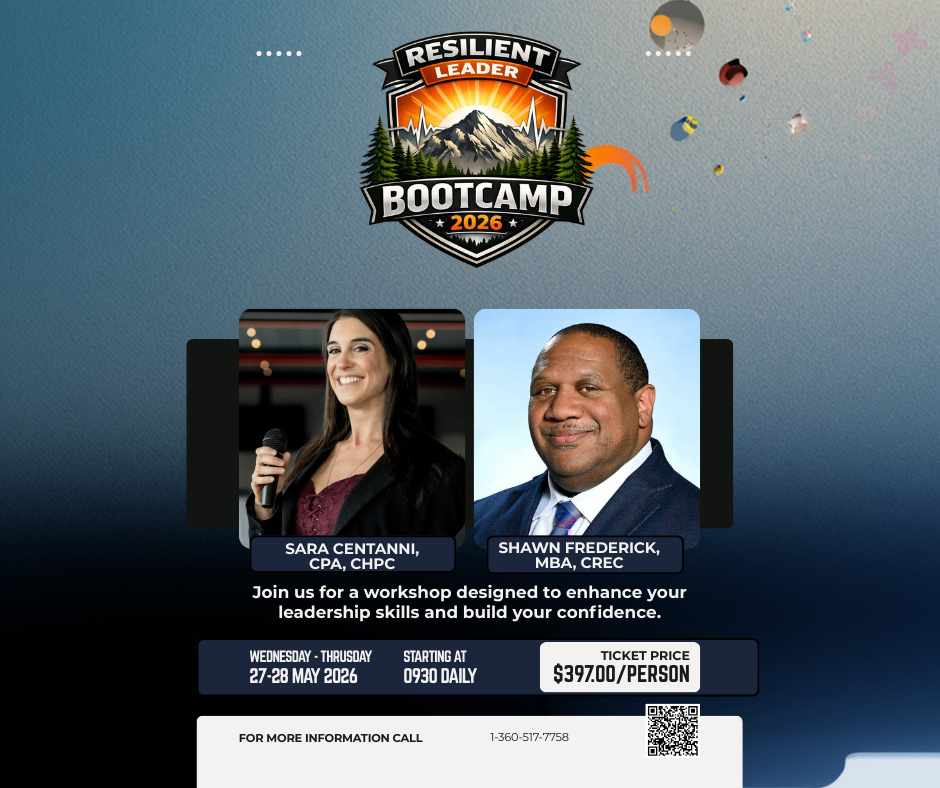
Tickets are $397, and it is a small investment in your long-term sustainability as a leader. You can learn more and register here.
Final Thoughts
Leadership in 2026 is harder than it’s ever been. The systems are strained, and the demands are higher. But remember: you aren't a failure because you feel the weight of a broken culture. You are a human being operating in a complex environment.
Build your resilience. Secure your oxygen mask. Then, use that strength to start redesigning the world around you.
Together, we can move beyond just "surviving" the system and start building organizations that are actually worthy of the people who work in them.
Stay resilient,
Shawn Frederick Founder, Frederick Solutions LLC


Comments