

Leadership Resilience Matters: How to Lead Effectively When the System is Broken and Budgets are Tight
Let’s be honest for a second. If you’re leading a team in healthcare, public health, or behavioral health right now, you probably feel like you’re trying to build a plane while it’s in a nosedive: and someone just told you there’s no budget for parts.
I talk to leaders every week who are exhausted. The systems are strained, the workforce is depleted, and the traditional "wellness" advice: like taking a yoga class or using a meditation app: feels almost insulting when you’re staring at a $0 increase in your operational budget.
But here is the reality we have to face: The system might stay broken for a while. The budgets might stay tight for the foreseeable future. If we wait for the "environment" to improve before we start leading effectively again, we’re going to lose our best people, and we’re going to lose ourselves to leadership burnout.
The good news? Leadership resilience isn't about the resources you have; it’s about the mental framework you operate from. It’s a learnable, repeatable skill set that allows you to maintain organizational culture and your own well-being, even when the external world is in chaos.
Why the System Won’t Save You (And Why That’s Your Superpower)
I’ve seen it firsthand: leaders who wait for "better times" to start investing in their team’s culture usually end up presiding over a ghost town. When resources are scarce, your most valuable currency isn't money: it's trust, clarity, and mental resilience.
Resilience is often misunderstood. It’s not about "gritting your teeth" or "toughing it out." In fact, that kind of hyper-stoicism is often a fast track to a breakdown. True leadership resilience is the ability to anticipate disruption, adapt to it, and guide others through it without losing your sense of purpose.
When the system is broken, your job isn't to fix the entire system. Your job is to protect the ecosystem of your team. You do that by shifting your focus from what you lack to how you lead.

The 5Fs Framework: Leading Through Constraint
When budgets are tight, you need a lean framework for decision-making. I’ve found that the "5Fs" are incredibly effective for maintaining momentum when things get messy:
Focus: When everything feels like an emergency, nothing is. You have to be the arbiter of what actually matters. Strategic clarity is the greatest gift you can give a stressed-team.
Fast: In a crisis, a "good" decision made today is often better than a "perfect" decision made next month. Reduce the lag time in your communication.
Flexible: If the original plan is no longer funded or feasible, don't mourn it. Pivot. Resilience is about being "bouncy," not rigid.
Fearless: This doesn't mean you aren't afraid; it means you’re willing to experiment. When the old ways aren't working, the risk of trying something new is actually lower than the risk of staying stagnant.
Fun: I know, it sounds counterintuitive. But if you can’t find moments of levity with your team, the weight of the work will crush the culture. Fun is a survival strategy.
Cultivating Psychological Safety Without a Line Item
One of the biggest mistakes leaders make when budgets are cut is that they stop communicating. They go into "bunker mode," trying to solve everything behind closed doors to avoid worrying their staff.
Stop doing that.
Transparency is free. Vulnerability is free. And these are the two primary ingredients of psychological safety. If your team knows exactly what the constraints are, they can help you find creative solutions. If they’re left in the dark, they will fill that silence with fear and rumors.
I’ve found that when leaders model vulnerability: acknowledging that they, too, are navigating a difficult path: it gives the team permission to do the same. This builds a culture of "we’re in this together," which is the ultimate burnout prevention training. You don't need a consultant or a fancy retreat to tell your team, "This is hard, here is what I know, and here is how we’re going to support each other."
Protecting Your Energy: The Leader’s Only Non-Negotiable
You’ve heard it a thousand times: you can’t pour from an empty cup. But as a leader, your energy isn't just a personal asset: it's a public one. Your team picks up on your "vibe" before you even open your mouth. If you are vibrating with anxiety, they will be too.
This is where mental resilience becomes a professional discipline. It means:
Setting boundaries: Protecting your time so you have space to think, not just react.
Emotional regulation: Learning to process the frustration of a broken system so you don't leak it onto your direct reports.
Detached self-awareness: Being able to look at a budget crisis and say, "This is a problem to solve," rather than "This is a failure of my worth."
Think of resilience as a muscle. You don't build it when things are easy; you build it by lifting the heavy weights of crisis and constraint. Every time you navigate a difficult day without losing your cool, you are training your brain for the next level of leadership.
Why "Wellness Programs" Are Often the Wrong Answer
I’ve seen so many organizations throw money at wellness apps while their leaders are still drowning in workforce shortages. It doesn’t work. Resilience isn't an "add-on" you do after work; it’s a way you operate during work.
If you want to stop the bleed of talent in your organization, you don't need more "perks." You need more resilient leaders. You need people who can walk into a room, acknowledge the chaos, and still provide a sense of direction. That kind of leadership creates an environment where people want to stay, even when the work is hard.
Moving from Surviving to Thriving
It is entirely possible to lead a high-performing team in a low-resource environment. In fact, some of the most innovative breakthroughs in healthcare and public health have come from moments of extreme constraint.
When you stop fighting the reality of the broken system and start mastering your response to it, everything changes. You stop being a victim of the budget and start being the architect of the culture.
But you don't have to figure this out alone. Resilience is a practice, and like any practice, it’s better with a coach and a community.
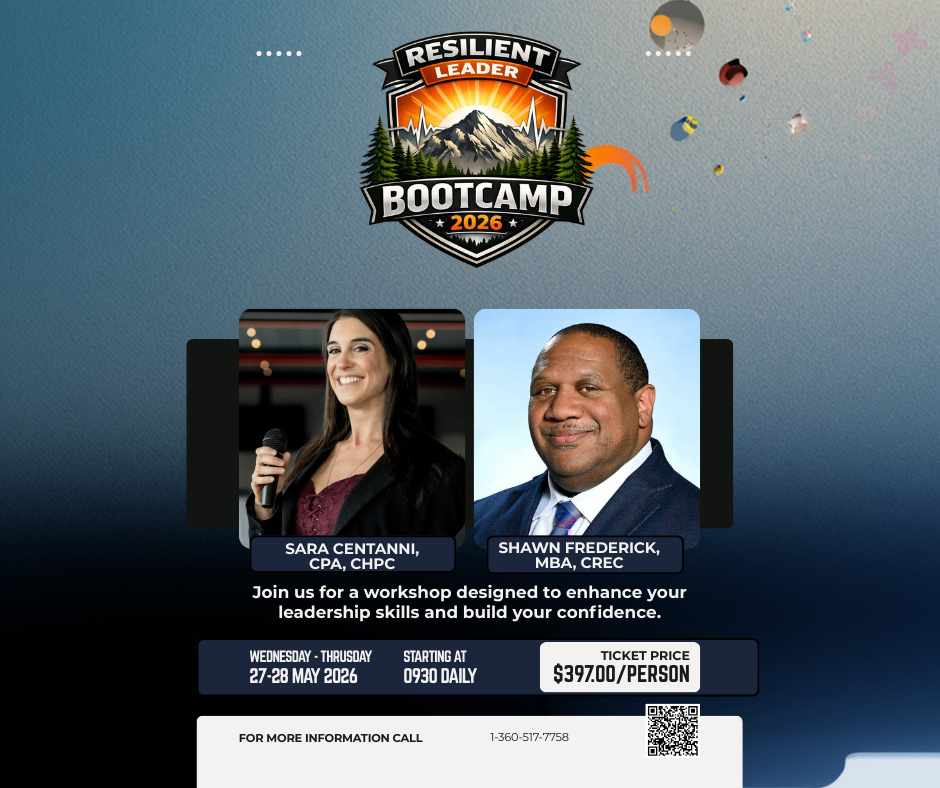
Join Us: The Resilient Leader Bootcamp 2026
If you’re ready to move past the "grit" phase and start building a sustainable, high-impact leadership style, I want to invite you to join us.
On May 27-28, 2026, in Lake Stevens, we are hosting the Resilient Leader Bootcamp. This isn't your typical corporate retreat. This is a deep dive into the practical, tactical strategies for mental resilience, burnout prevention, and leading through crisis.
We’ll show you how to:
Navigate workforce shortages without burning out.
Build psychological safety when resources are zero.
Master your internal state so you can lead with confidence, regardless of the budget.
Space is limited because we keep these sessions interactive and high-impact. If you're tired of just surviving and you're ready to start leading again, this is for you.
[Register for the Resilient Leader Bootcamp here]
The system might be broken, and the budget might be tight: but your leadership doesn't have to be. Let’s build the resilience you need to thrive anyway.
Stay strong, Shawn


Comments